All of the seasons represent change, but autumn can speak the loudest of all. Vibrant colors, shifting landscapes, beauty that transforms itself overnight — each day a new venue, inspiring us with a renewed sense of awe and wonder. I captured this photo this morning, for instance, and decided to share it here to introduce a guest post by K.L. Stover.
One of my goals here in SunnyRoomStudio–a creative, sunny space for kindred spirits–is to bring in new voices from time to time to celebrate and showcase the unique contribution of others. And, certainly, Keith has captured the spirit of this sunny space with today’s post. We all grow and change during a lifetime, but is there a theme in the background … something that gently pulls us along as we explore the deepest truths, our spiritual natures, the mysteries of a mortal journey?
Let’s see what Keith has to say about that question. I think you’ll find his thoughts intriguing and thought provoking. An artist of many persuasions who isn’t afraid to tackle difficult subjects, Keith writes from the lovely state of Maine.
But before I share his guest piece, I had to let you know we had another visitor this morning in the evergreens behind our home. If you look closely in the branches, you’ll see a large owl peering out at you with knowing eyes. A zoom lens might have helped to bring him into focus, but in the moment, there was no time for details. So here’s his picture, or hers, a Dakota owl with a place of honor in SunnyRoomStudio.
Metamorphosis via Art
by K. L. Stover
All truths wait in all things;
They neither hasten their own delivery,
nor resist it;
They do not need the obstetric forceps
of the surgeon;
The insignificant is as big to me
as any;
(What is less or more than a touch?)
Logic and sermons never convince;
The damp of the night drives deeper into my soul.
Only what proves itself to every man and woman is so;
Only what nobody denies is so.
-Walt Whitman, “Song of Myself” 1855
Working as an artist for the past 40 years has seemed, at times, both a privilege and a curse. A privilege to have been given creative gifts and a natural inclination toward a refined sensibility; a curse because the artist’s existence can be lonely, desolate and despairing at times.
If it is ever really possible to get used to haunting the existential margins, then I suppose a pure artist does so, pursuing the Muse wherever it may lead, hoping to capture and express a personal creative vision. Indeed, artistry itself is, in many ways, the absolute paragon of individuality.
To many people the term artist connotes someone who works with a visual medium—a painter, for instance—and this is understandable. My own personal definition of art is “ideation made manifest.” In other words, until creative ideas are fixed into a form that someone else can recognize, it’s not really art, because art is a vehicle of communication, a shared connection.
And I, unfortunately, was not born with the gift of painting or drawing. I’m afraid I would have made a poor cave man, as even my stick figures would be poorly rendered.
Thankfully, artists come in all shapes and sizes and art takes many forms.
I am primarily an expressionist—novelist, poet, musician, lyricist, photographer, essayist, journalist. Words are my primary medium, music second. But whenever I enter into a serious discussion of art, I have learned to add another multi-dimensional avenue of expression: philosophy.
Beyond Self
The tendency to look at things philosophically seems to be increasing commensurately for me with advancing age. In fact, my worldview seems to have more than doubled since my 20s. It seems that this process is both natural and normal, as the big picture for most of us at 25 is little more than a big picture of ourselves.
While we tend to frame maturation in terms of our shared socialization, I suspect that biology might well play a larger role in this phenomenon than we are aware. After all, the transitions from childhood to adolescence to adulthood are powerful and complex, demanding that we learn to know and define who we are as individuals in order to fully assume our fully-formed identities. Eventually, however, a hyper sense of self-awareness gives way to a more inclusive world view. There is no substitute for the broadening of our horizons which time naturally brings.
Looking back three decades, I can see now what I didn’t then—that life itself is a metamorphosis and all people and all things are in a constant state of becoming. I have learned this truth directly and personally from a combination of art, philosophy and spiritual awareness.
I have been studying philosophy, ontology and teleology quite intensely for at least the past two decades, using philosophy to distill the essence of a thing from the complex layers of our human constructs in an attempt to try and derive personal meaning, purpose and significance from it.
In a perpetual effort to try and understand the troubled world we find ourselves in, my chief area of philosophical study has centered on post postmodern existentialism. And I define this philosophy as the growing dynamic tension between the values of the private and the public, the historical and the emergent, the traditional and the cutting edge, the individual and the collective, the citizen and the nation state, all occasioned by the emergence of modern technology, mass production and the increase of individual choices.
But I am also fascinated by Platonic dialectics, Renaissance Enlightenment thought and Marshall McLuhan’s communication theories.
Much like a classical painter, as a conceptual artist, I have moved freely throughout my career from abstraction to surrealism and back again. However, at some point, I embraced transcendentalism, experiencing a sense of liberation that allowed me to shed the shackles of conformity to try and remove any barriers blocking the various paths to truth. And, now, feel I am well down the path of spiritual and artistic metamorphosis.

"AMAZING GRAZE" courtesy of Julia Bayly. --- Photo taken in Patton, Maine, with Mt. Katahdin (famous peak in Maine) in distance
Seeking Truth
Like many artists, I am a natural truth-seeker who has always found religion stifling. I’ve often blamed it on the strictures of the rural New England Baptist church in which I was raised (an institution I traded for rock and roll as a teenager when the minister told me I had a choice of attending his church or dancing to the music of the Beatles) —but today I am sure it goes far deeper than mere religious affiliation.
If there is one overarching truth that my study of philosophy has taught me, it is that all truth is individual; while there are larger ontological parameters (the finite universe, life and death), there is no such thing as a collective truth, only endless variations of personal ones. And this—the sharing of our individual truths—is the chief function that storytelling serves. Whether it be prose, poetry, music, painting, sculpture or dance, artistic expression is a time-honored way of comparing notes.
I believe the role of the artist is an important one—to change an existing perspective or to offer an original one. And I take this role seriously. This is why I often draw a line between artistic expression and entertainment. While I like a good book or album or movie as much as the next person, I often see entertainment as the antithesis of art—crassly commercial, populist, dumbed-down, lowest-common-denominator fare, escapism driven in the service of blatant capitalism. I have been told that this is an elitist viewpoint, an observation I won’t deny. This bias is a by-product of a fully-developed aesthetical philosophy.
A few years ago, after reading Umberto Eco’s excellent book the Philosophy of Thomas Aquinas, my eyes were opened to new and exciting ideas. Indeed, from this sprang the foundation for my Philosophy of Aesthetics; it illuminates the power of art and is best expressed like this:
In the 21st century, the historical paradigms of power have shifted from religious and spiritual ones toward those whose influences are directly manifested in some form of material wealth. I see this as the eventual death knell of the higher man. Art is our only hope. In fact, it is my belief that art is the lucid tongue of the creative spirit, and artists in all cultures should be valued as high ambassadors of our civilization.
The works of Eco and Aquinas also led me to formulate a “Unification Field Theory of the Science of Aesthetics,” which combines the physiological (sentient perception) the ontological (being), the teleological (design/purpose) and the ethical/moral (good/bad, right/wrong,). These combined fields form the basis of aesthetic judgment, the very cornerstone of the skill-set needed to understand and appreciate both Art and Truth.
This refined aesthetic sensibility has moved me simultaneously toward a clearly-defined personal artistic vision (succinctly, truth through art) and a better understanding of what Plato referred to as “universals,” those things which all people have in common and which bind us all across oceans and centuries.
Much of the time I am convinced we have not evolved much intellectually from those wise and ancient Greeks, who joined Western ideas of freedom with Far Eastern ideas of balance. The Greeks loosely defined civilization as an attempt to “pull order from chaos.” But in the process of attempting clarification en masse, we have, over centuries, added layer upon layer of artifice and constructionism to our Consensus Reality.
At times, it seems our social complexity and sophistication have paralyzed us.
Truth and Art
Ours is at once an age of moral relativism, revisionist history (in praise of the late Howard Zinn) social constructionism and exponential technologies which evolve at a rate many times faster than human growth. And the combination of these factors is not only dangerous, but potentially fatal to humankind.
If simplicity bleeds elegance, then we are in trouble.
While technological innovation steadily and dramatically impacts man’s physical reality in quantifiable terms, his thoughts, ideas and emotions, his psychic adjustments to these changes, remain fluid and nonhomogeneous. And art, and perhaps only art, is perfectly suited to the task of capturing and preserving these adjustments.
Because most meaningful art—certainly literary, musical and visual works—is directed toward posterity, it produces cultural snapshots which offer the artist and the audience both content and context. And in the post postmodern power vacuum created by the absence of historical classicism, this is quite important.
While the culture of technology is marked by both volubility and volatility, art, in essence, offers frozen perspective on the one hand and a living, vital, viable historical legacy on the other. Where science is preoccupied with definition, quantification, hypothesis and methodological application, art has the advantage of both objectivism and subjectivism, physical and metaphysical exploration.
What better vehicle than art to carry the ethos, pathos and zeitgeist of the modern citizenry? For art is not just a technological extension of mankind’s communication but also an extension of its deepest debates.
As a direct result of information technology, we spend much of our time examining the dynamics between personal visions and group ideologies, interest groups and governments, states and nations, alliances and confederations.
Unfortunately, the most basic dynamic of all, the effect that nature has on our individual and collective sense of spiritual well-being—our breath in concert with the wind in the trees—has been criminally ignored.
While it may be true that not all artists are spiritual, any true aesthete (like Whitman) has an appreciation of nature. And Sunny Room Studio reminds us that if nature is, in fact, a manifestation of some superior or universal mind, then our individual wonder, awe, and humility are the evidence of its unfathomable mystery.
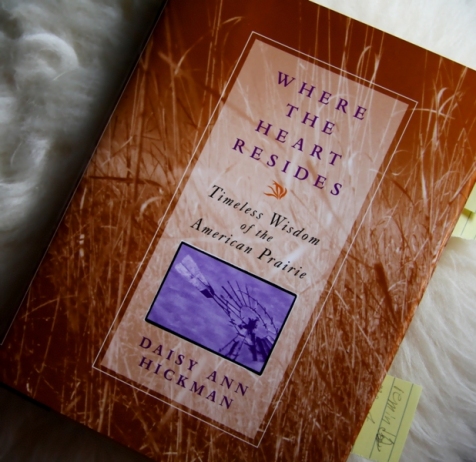
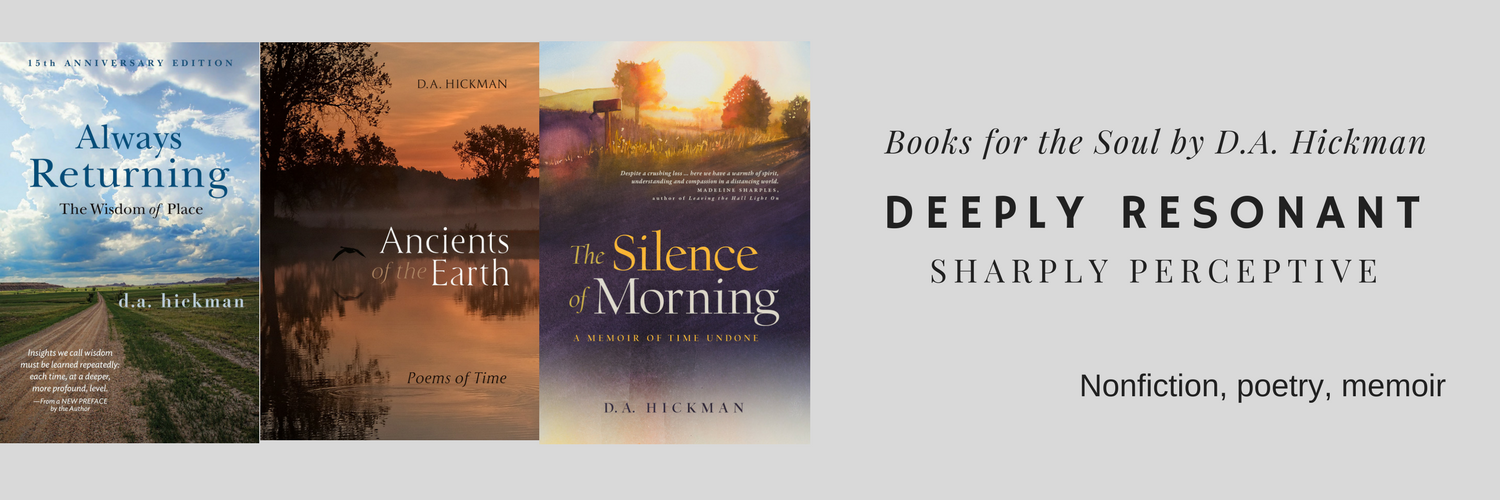
As a Maine native, I have never been to the heartland of America, but as an artist and thinker, I can easily see that Daisy Hickman’s beloved prairie lands are a metaphor for the wonder she finds from looking out the windows of her soul. Hers is the same type of transcendentalism embraced by Whitman, Emerson and Thoreau, who recognized the liberation inherent in refining our sensibilities and trusting our intuitive senses.
As evidenced by the direction of Western civilization and our global society, we desperately need to return to the exploration of these values.
The ancient Greek Philosophy of Aesthetics said, “Where there is Beauty, Truth is near.” And the truth is this: information in and of itself is no substitute for wisdom and art might be humanity’s best vehicle to explore truth.
↔
K.L. Stover links:
Biographic Profile
Partial Portfolio
Facebook
Author Note:
Keith Stover is at work on his third novel and is interested in connecting with potential literary agents via representation or with publishers.
Please see links above for details.
You can also return to this blog post anytime in the future via this link @ http://tinyurl.com/2dpxgkd
↔
Thanks so much for stopping by SunnyRoomStudio – hope you had a pleasant visit! And thank you, Keith, for sharing your thoughts here for others to ponder. Shedding light on important subjects is clearly another priority here in this sunny room, and you have done that well. Thanks also for connecting with Julia Bayly re her lovely Maine photograph.
- Look forward to seeing all of you here again next week.
In the meantime, after reading Keith’s guest post, what do you think? What is the role of art, how has it impacted your life — what is the relationship between art and truth? While there are many ways to define art and truth, the connection between the two is always intriguing. I hope you’ll share your ideas in a comment below and Keith, or myself, will respond as quickly as possible.
Best wishes, always, from SunnyRoomStudio: a sunny, creative space for kindred spirits.
↔
Here again is our Dakota owl … looking down at us this morning!

Blog by DazyDayWriter @ work in SunnyRoomStudio: rights reserved.
Genuine Wonder
I’m very pleased to have Jen Knox here as my Studio Guest for the next few days. And I’m especially glad that Jen chose to tackle a prickly subject like writer’s block. While the debate rages on about whether or not the affliction exists, she artfully enlightens us with the truth of the matter. Author and creative writing instructor at San Antonio College, please help me welcome Jen Knox to SunnyRoomStudio.
Jen Knox is the author of Musical Chairs and To Begin Again (Next Generation Indie Book Award winner, Short Fiction; Readers Favorite Award, Women’s Fiction). Jen received her MFA from Bennington’s Writing Seminars and currently works as a creative writing instructor at San Antonio College. Her short stories and essays have been published in Annalemma, Gargoyle, Metazen, Narrative, Short Story America, Superstition Review and elsewhere. She posts about the writing life and her work here: http://www.jenknox.com
by
Jen Knox
There is no such thing as writer’s block. When I make such an assertion in class, my students often need further convincing. As a phrase, “writer’s block” suggests what? The writer is facing an obstruction to the very act of writing. This is extreme. Let’s consider the phrase itself—it’s a metaphor, a way of explaining a feeling many writers face. Writer’s block is a creative way of describing something as simple as fear. The fact that the very phrase is creative, that it was most definitely thought up by a writer, seems intrinsic proof that it is not a reflection of reality.
I teach creative writing at a community college, and in my course each student writes three complete stories. It’s a lot to ask in a matter of mere weeks, I realize, so I’m not surprised by the fact that at least once each term a panicked student approaches me and says, “I can’t do it. I keep trying, and nothing is coming out.” At this point, I ask how, exactly, the writer has been trying. I usually get one of two answers. Either everything the writer starts is “horrible”, leaving him or her to a cycle of perpetual false starts; or, the writer has been thinking and thinking, and “just can’t” sit down and put words to paper.
Both answers suggest that the writer cares deeply about his or her work and what’s really at play is not that the writer can’t tell a story; it is that the writer fears not telling a good-enough story. Incidentally, I rarely hear such a complaint coming from a student who, upon introductions, says that creative writing is just a new and fun thing to try. Such students, in fact, are often the most prolific. The ones that believe in writer’s block are the ones that identify themselves as writers, who have been doing it awhile, and I think there’s good reason for this trend.
“Do you want me to write about what I see?” students inevitably ask. And when I tell them it doesn’t much matter, they often look at me like I’m insane. To this, I smile.
This exercise—the simplicity of going somewhere new—is purely experiential, but it is not without purpose. When writers return, armed with details about their excursions, I tell them to pay less attention to the details and more to the keenness of their perception—how it was piqued in the new situation or area. The feeling of novelty awakens in us a sense of wonder. It shakes us, wakes us up a little. It is the very same feeling of the brand new writer, the writer who is not yet thinking of publishing, revisions, rewriting or anyone else reading the work. The cure to fears that surround writing is to—no matter how far along we get in our careers—approach the blank page as the new writer does, approach it as a new and fun thing to try, just one more time. And if you must, go somewhere new and awaken that sensation before sitting down to write.
But a true story, a true piece of writing in any form, is not created from a desire to be good but a desire to understand. Remembering that will keep us going. And if we forget every now and then, hey, it just means we care. Now: back to it, there’s so much newness to explore. ~
Barbara Hammond is an Artist, Writer/Blogger and Published Author and illustrator of The Duffy Chronicles, her first children’s book.